


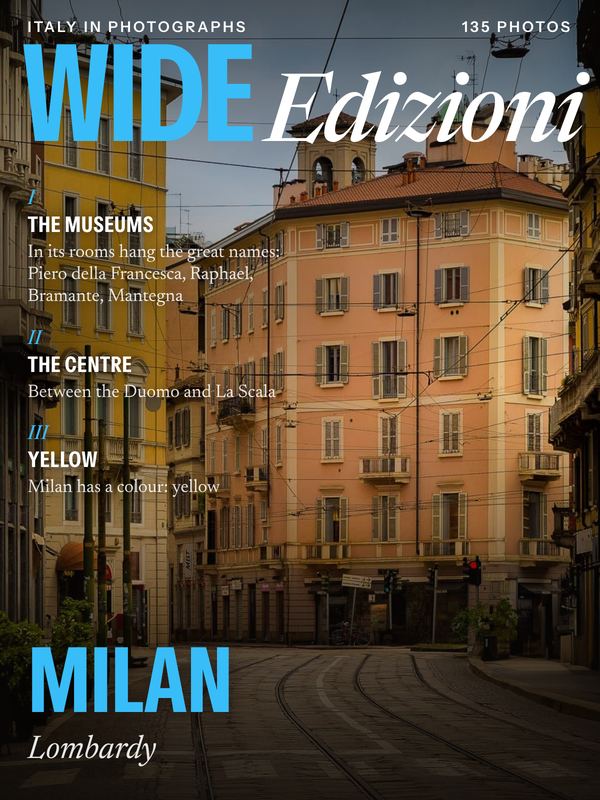
Looking up
Milan does not give itself away at first glance. It is a city to look at with your head tilted back, towards cornices, balconies and terraces, and to peer into behind its great doors, where courtyards and gardens open up.
These pages cross it on foot: from the museums and their gilded frames to the Galleria, from the yellow façades to the narrow streets, from the Liberty palazzi to the brick churches, and on to Parco Sempione.
A Milan in no hurry, far from the picture people have of it.
In the book
- I
The museums
The Pinacoteca di Brera opened on 15 August 1809, Napoleon’s birthday, in the palazzo that Francesco Maria Richini had rebuilt in the seventeenth century.
- II
The centre
Between the Duomo and La Scala, the Galleria Vittorio Emanuele II is the Milanese living room. Designed by Giuseppe Mengoni, it was built between 1865 and 1877: two streets crossing beneath a vault of iron and glass.
- III
Yellow
Milan has a colour: yellow. On the façades, on the historic trams, and for years on the taxis.
- IV
The streets
Away from the big avenues, Milan is made of narrow, quiet streets, of palazzi that face each other at close range, of tram wires strung above the road.
- V
Doors and courtyards
Milan does not show itself: it hides behind its doors. One left open is enough to glimpse courtyards, gardens, grand staircases, fountains.
- VI
The façades
At the start of the twentieth century Milan discovered Liberty, the Italian Art Nouveau. Corso Venezia and Porta Venezia were its cradle, and Giuseppe Sommaruga’s Palazzo Castiglioni (1901–1904) is its manifesto.
- VII
Palaces and churches
Milan has brick churches and marble churches, Renaissance palazzi and nineteenth-century palazzi, often in the same block.
- VIII
The park and the castle
Behind the Castello Sforzesco lies Parco Sempione, the great park of the centre. It still holds the Acquario Civico, the only surviving building from the 1906 Exhibition.


