


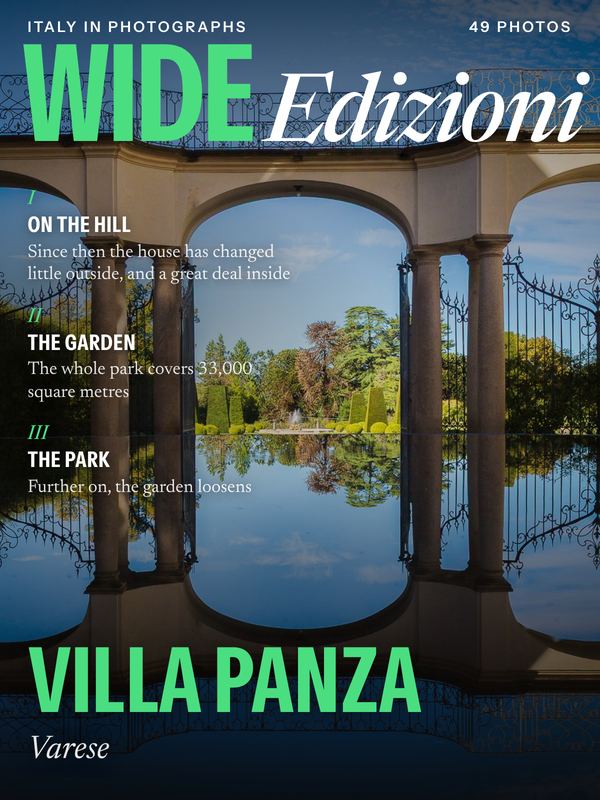
A hanging garden
On Biumo hill, above Varese, a villa looks out over the town from a garden that almost seems to float. In the mid-eighteenth century the Marquis Paolo Antonio Menafoglio had great walls raised and filled with earth, creating a terrace on which to set house and garden.
Then came the Litta family, the architect Luigi Canonica and, in 1935, the Panza family. From 1955 Giuseppe Panza made it one of the best-known homes of contemporary art in the world; in 1996 he and his wife Giovanna donated it to FAI.
These pages explore it like a walk: the villa, the garden, the park, the rooms, the light.
In the book
- I
On the hill
The villa is U-shaped, open towards the garden: three storeys, pale plaster, green shutters.
- II
The garden
In front of the villa, green turns into geometry: mown lawns, hedges clipped into cones, rows of spheres, fountains, gravel paths. The whole park covers 33,000 square metres.
- III
The park
Further on, the garden loosens. In the nineteenth century the park was redesigned in the English style: wide lawns, single trees and romantic corners, such as the pond and the mound with the ice-house grotto, topped by a little temple.
- IV
The rooms
Inside, the villa keeps its neoclassical halls, crystal chandeliers and gilded stucco. Giuseppe Panza set beside them works about light and colour: from 1955 until his death in 2010 he gathered more than 2,500 works of European and American contemporary art, and about 150 are on show here.
- V
The light
The heart of the collection lies in the Rustici, the villa’s former stables and coach houses. Here Dan Flavin, James Turrell and Robert Irwin created works designed for these spaces.


