


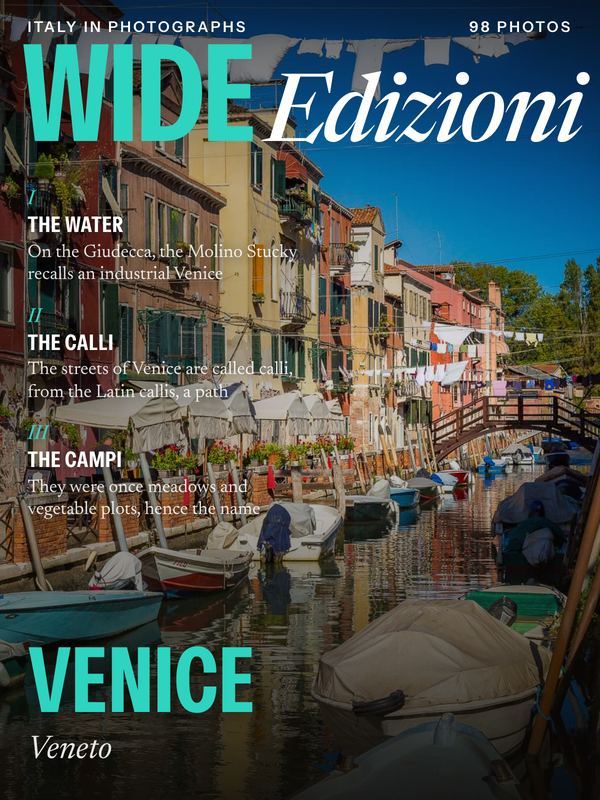
The other Venice
People usually look at Venice from St Mark’s Square. These pages look at it from behind: from the calli where washing hangs out to dry, from the campi and their wells, from the rii where boats are moored outside the front door.
This is the city where people live: the Giudecca, the campi and rii of the sestieri, the tree-lined avenues of Castello, and on to the island of Sant’Elena at the eastern tip.
A city with words of its own: calli, campi, rii, fondamenta. You will meet them one by one.
In the book
- I
The water
In Venice the water is the main street: people take a boat the way others take a car.
- II
The calli
The streets of Venice are called calli, from the Latin callis, a path.
- III
The campi
They say Venice has only one piazza, St Mark’s: all the other squares are called campi. They were once meadows and vegetable plots, hence the name.
- IV
The rii
The smallest canals are called rii. Along their banks run the fondamenta, the stone quays the houses face onto.
- V
The greenhouse and the gardens
Towards the eastern tip, in the sestiere of Castello, Venice turns green. The Giardini were ordered by Napoleon in 1807 and designed by Giannantonio Selva; since 1895 they have hosted the Biennale.
- VI
Houses among the trees
Further on, the island of Sant’Elena is one of the greenest corners of Venice: a quiet neighbourhood, lawns, and a large pine wood on the lagoon, created in the early decades of the twentieth century.


